

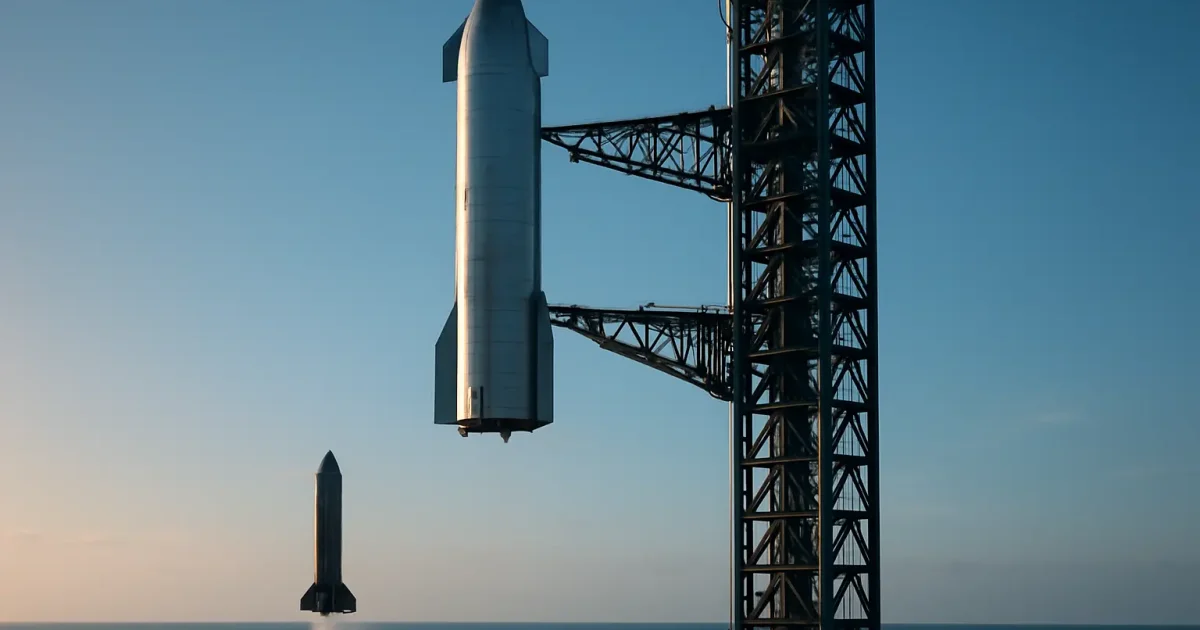
On its 15th test flight, Starship's Ship returned from orbit after about 22 and a half hours and was caught by the launch tower's 'chopsticks' in Texas, while the Super Heavy booster aborted its catch and ended in the ocean.
SpaceX has caught the upper stage of its Starship rocket with the mechanical arms of its launch tower for the first time, completing a flight that lasted about 22 and a half hours. The 124-metre rocket lifted off from Starbase in Boca Chica, Texas, at 16:47 local time (19:47 GMT) on Friday, 13 November, on the programme's 15th test flight. The Ship, as the upper stage is known, deployed 26 Starlink internet satellites, completed 14 orbits of Earth and then flew back to hover beside the tower, whose arms, nicknamed 'chopsticks', secured it on Saturday. The BBC and Aviation Week both reported the catch as a first for the upper stage, which only reached orbit for the first time in September.
The flight was the first attempt to recover both parts of Starship, and it fell short of that goal. About six and a half minutes after launch, the Super Heavy booster was due to return to the tower, but it triggered an automated abort, diverted to the ocean, hovered above the water and then exploded. Elon Musk later wrote on X that the booster had been 'slightly low on fuel'. SpaceX has caught Super Heavy boosters on three earlier test flights, and the company had said before launch that it would only attempt the Ship catch after assessing the vehicle's condition in space; any problem would have sent the Ship into the ocean instead.
Full reuse of both stages is central to SpaceX's plan to cut launch costs, as reusable Falcon 9 boosters did after the company first landed one vertically in 2015. Professor Malcolm Macdonald, president of the Royal Aeronautical Society, told the BBC that losing the booster was a setback but that recovering the Ship was 'a substantial step forward', adding that the next milestone is to combine both catches on one flight and prove they can be done 'reliably, repeatedly and economically'. The result is also closely watched by NASA, which has contracted SpaceX to adapt the Ship into a lunar lander for its Artemis programme, alongside Blue Origin, with a crewed Moon landing targeted for 2028.