

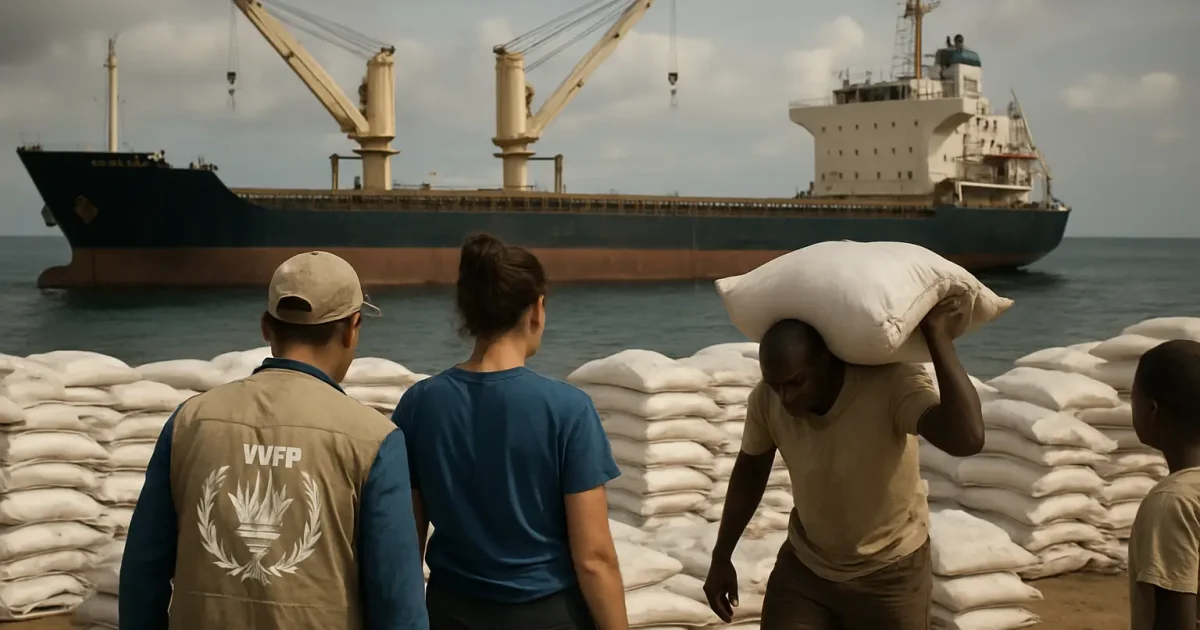
WFP chief Luke Lindberg told the UN Security Council that war-hit shipping routes could add $727 million in costs by mid-2027 and cut aid for 7.3 million.
The head of the World Food Programme warned the UN Security Council on Monday that wars disrupting key shipping routes could raise the agency's costs by $727 million by mid-2027, putting food assistance for 7.3 million more people at risk. Luke Lindberg, who took charge of the Rome-based agency in September, said food exports and farm inputs moving through the Strait of Hormuz, the Bab el-Mandeb Strait and the Black Sea were being squeezed at the same time, a situation he called a "triple choke point". He told the council that 266 million people already face acute hunger, with a risk of famine in parts of Sudan, South Sudan and Somalia, according to WFP's transcript of his remarks and a Reuters report.
The briefing came during a council meeting on Ukraine, called as Russian strikes on the country's power grid and attacks on merchant ships in the Black Sea intensified. Lindberg said the number of wheat and maize vessels passing through the Bosphorus by mid-October was 63 percent lower than a year earlier, and that about 10 million tons of Russian and Ukrainian wheat may not reach world markets this year, enough to feed 44 million people. Grain silos in Ukraine and Poland are full while families in Sudan and Somalia go hungry, he said. "This is not a problem of production. It is a political problem," Lindberg told diplomats. El Niño and a near four-year high in the FAO Food Price Index in September have added to the pressure.
Lindberg asked the council to back a strictly humanitarian mechanism that would let WFP facilitate grain shipments from both Russia and Ukraine, an idea that recalls the UN-brokered Black Sea Grain Initiative of 2022 and 2023. Such an arrangement would require clear coordination mechanisms, he said. Attacks at sea have not stopped: ships flagged to Greece, Liberia and Somalia were hit in mid-November, and Ukraine said it struck two Russian vessels off Libya at the weekend. WFP also expects lower yields from the next harvest, because planting in parts of Africa and Asia coincided with the escalation in the Middle East. It is not yet clear whether donors will fund the extra costs, which will decide how many of the 7.3 million people keep receiving help.