
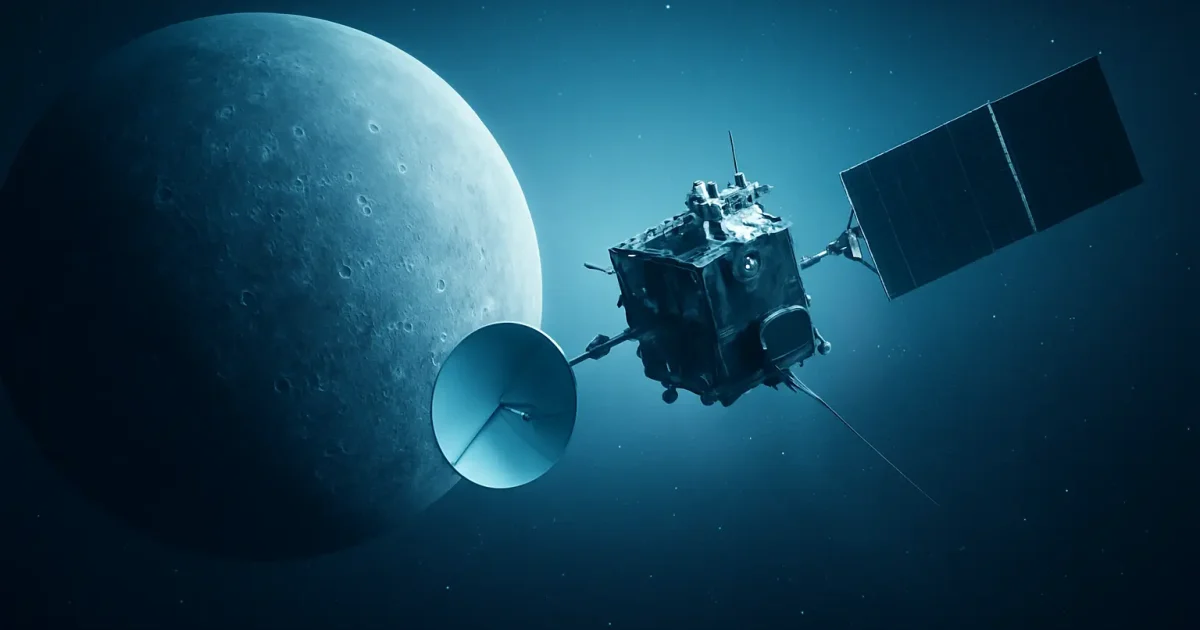
ESA and JAXA's BepiColombo entered orbit around Mercury on 21 November, only the second mission ever to do so. Its two probes will separate on 9-10 December.
The joint European-Japanese BepiColombo mission entered orbit around Mercury on 21 November 2026, ending a cruise of more than eight years that began with an Ariane 5 launch from Kourou in October 2018. The European Space Agency announced that the still-joined spacecraft had been captured by the planet's gravity, making it only the second mission ever to orbit Mercury after NASA's MESSENGER, which worked there from 2011 to 2015. BepiColombo carries two science probes: ESA's Mercury Planetary Orbiter (MPO) and the Japan Aerospace Exploration Agency's Mio. They travelled stacked together and will now spend several months moving into their own orbits.
Reaching the innermost planet is harder than it sounds. A spacecraft falling toward the Sun picks up speed, so BepiColombo needed nine planetary flybys, one of Earth, two of Venus and six of Mercury, plus long stretches of ion-engine thrust to slow down enough to be captured. Emma Bunce of the University of Leicester, a lead mission scientist, told Nature that getting to Mercury takes more energy than travelling to the outer Solar System. The trip also ran late. A power problem with the thrusters in April 2024 pushed arrival back by about 11 months from December 2025. The propulsion module was dropped on 3 September, leaving the two orbiters to complete the approach on their own.
The next big step comes on 9 and 10 December, when Mio is due to separate and settle into a stretched elliptical orbit roughly 590 by 11,640 kilometres above the surface to study Mercury's magnetic field and how it interacts with the solar wind. MPO will then lower itself gradually, reaching a polar orbit of about 480 by 1,500 kilometres in March 2027, from where it will map the surface, its minerals and the planet's large iron core. ESA plans to start full science operations in April 2027. The nominal mission lasts one year, with an extension already planned through 2029. Its X-ray telescope, MIXS, has already passed tests during the cruise.