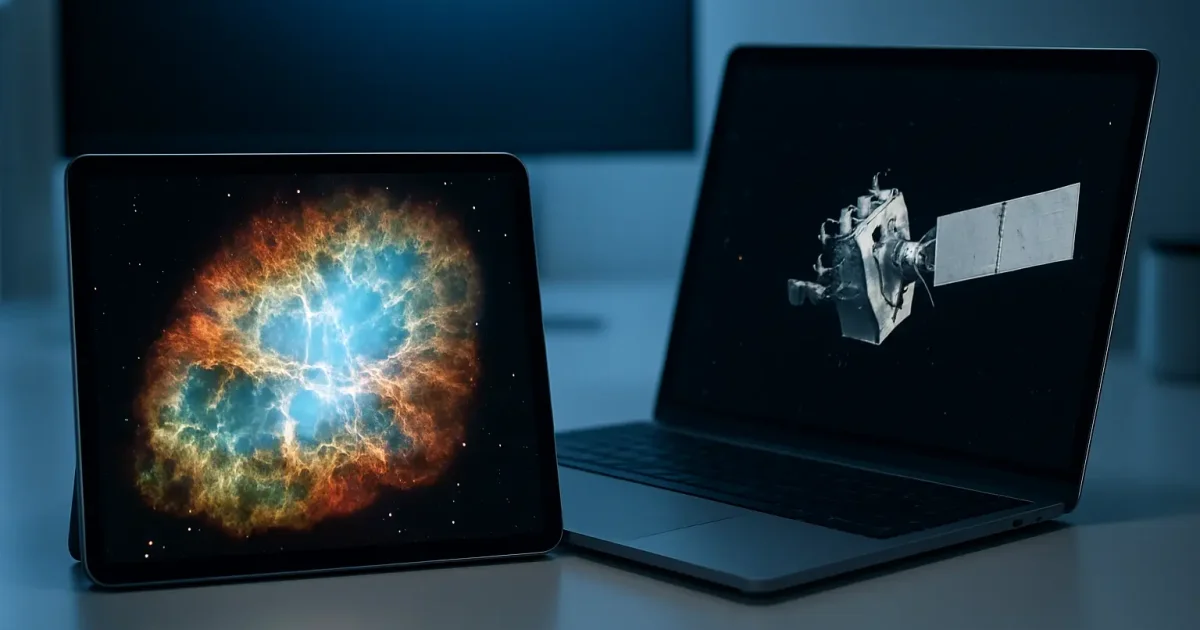
The UK-led MIXS instrument imaged the Crab Nebula in September, Leicester says, as ESA and JAXA's BepiColombo prepares to enter Mercury orbit on 21 November.
The first imaging X-ray telescope to fly on a planetary science mission has released its first picture since launch, the University of Leicester said on 20 November. The Mercury Imaging X-ray Spectrometer (MIXS), carried by the European Space Agency's Mercury Planetary Orbiter, observed the Crab Nebula, a well-studied X-ray source about 6,500 light years away, on 11 and 12 September 2026. The team ran 55 spacecraft turns and 39 hours of observations, pointing the telescope at different offsets from the target for 30 minutes at a time. According to Leicester, the sharpness of the image, known as angular resolution, came out slightly better than in laboratory tests carried out in 2015.
The check mattered because MIXS had spent eight years and about 10 billion km in space before it could be tested on a real target. Principal investigator Emma Bunce said the instrument is performing very well, with no stray-light problem and cosmic-ray effects that can be filtered out, although some effects will still be tuned during commissioning at Mercury. Instrument scientist Adrian Martindale said the hardware looks just as it did in the lab. Leicester says 80% of the technology on MIXS is new. It is the only UK-led science instrument on BepiColombo, a joint mission of ESA and Japan's JAXA launched on an Ariane 5 in October 2018. A solar panel power problem found in 2024 pushed its arrival back from December 2025.
The next step comes on Saturday 21 November, when ESA says the joined spacecraft will enter orbit around Mercury, starting a series of manoeuvres to lower and reshape its path. ESA's Mercury Planetary Orbiter and JAXA's Mio orbiter are due to separate on 9 and 10 December, and the science phase is set to begin in April 2027. MIXS will then map the X-rays that Mercury's surface gives off when it is hit by solar radiation, helped by the companion SIXS sensor, to reveal which chemical elements make up the planet's crust. Only one spacecraft, NASA's Messenger, has orbited Mercury before, and its mission ended in 2015.