
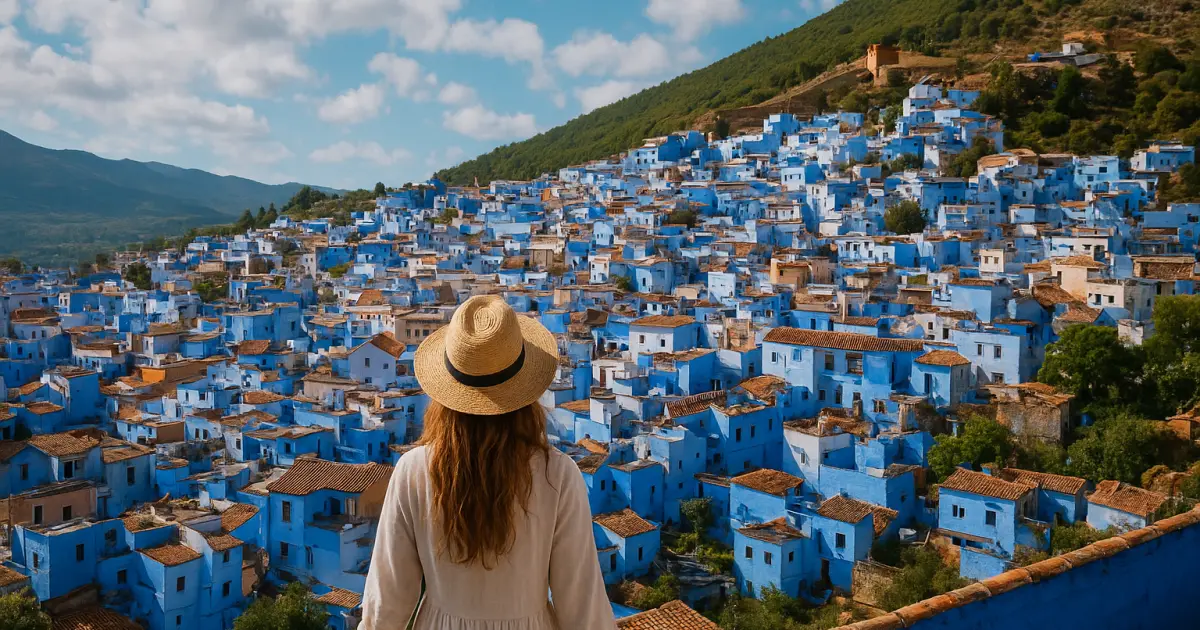
Tucked into Morocco's Rif Mountains, Chefchaouen is famous for its blue-washed medina. Here is how to explore its lanes, culture and surroundings, take better photos and travel respectfully.
Chefchaouen, colloquially known as Chaouen, lies in the western Rif Mountains of north-western Morocco, about 600 metres above sea level, between Tétouan and Ouazzane. Its name is usually explained as "look at the horns", a reference to the two peaks above the town. It was founded in 1471 by Ali ibn Rashid al-Alami, often called Moulay Ali Ben Rachid, as a small fortress, today's Kasbah, to defend the region against Portuguese attacks. During and after the Reconquista, Andalusi Muslims, Moriscos and Spanish and Portuguese Jews settled here, and their influence survives in Andalusian-style houses, arched lanes and a living tradition of Andalusian music. Spain occupied the town in 1920; it was part of Abd el-Krim's Rif Republic from 1924 to 1926 and returned to Moroccan rule at independence in 1956. Today its medina, painted in shades of blue and white, is the main draw. There are several theories about the colour: that it keeps mosquitoes away, that it symbolises the sky and heaven, or, according to some residents, that painting was encouraged in the 1970s to attract tourists. The lanes are steep and uneven, so comfortable shoes are essential.
The heart of the medina is Uta el Hammam Square (Place Outa el Hammam), a market square lined with shops and cafés and named after a public bathhouse in its north-west corner. The town's most important buildings stand around it. The Kasbah, the original rammed-earth citadel reinforced by towers, now holds a garden and a small museum of archaeology and ethnography. Beside it is the Great Mosque, the oldest and historically most important mosque in Chefchaouen, while a large historic caravanserai stands near the square and the old Souika quarter lies to the south-west. Just east of the medina, outside the former walls, is Ras el Ma, the spring that was the town's original water source. From there a path climbs to the disused Spanish Mosque, built in the 1920s on a hill to the east and now a popular lookout over the town. Local crafts include leather, textiles, ironwork and especially woodwork, the best-selling artisan product in the province. For nature, nearby Talassemtane National Park is a popular hiking area, home to rare fir forests and Barbary macaques, with attractions including the natural rock arch known as the Bridge of God and the village of Akchour.
For photography, the softest light usually comes early in the morning, before the lanes fill, and late in the afternoon. Many of the most photographed doorways and staircases belong to private homes, so keep your voice down, do not block entrances, and avoid climbing on steps or moving potted plants. Always ask before photographing people, especially women and older residents, and accept a refusal gracefully. Dress modestly, be mindful during prayer times and Ramadan, and do not enter a mosque unless you have confirmed that visitors are welcome. Responsible travel also means spending locally: stay in family-run guesthouses, eat in small restaurants and buy directly from artisans and cooperatives. The surrounding Rif is a major cannabis-growing region, but recreational use remains illegal in Morocco, so politely decline street offers. Tourism here is strongly seasonal, with summer and holidays bringing the biggest crowds of Moroccan and foreign visitors, so travelling outside those periods means calmer lanes. On hiking trails, use water sparingly and carry your rubbish out.