
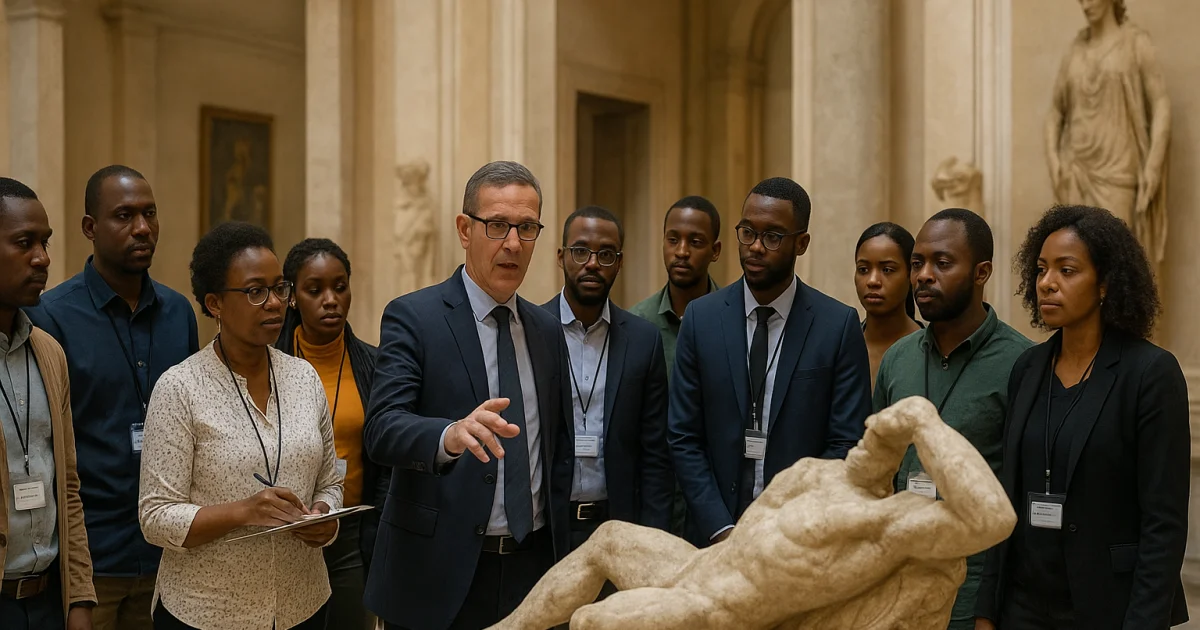
A new three-year programme under Italy's Piano Mattei teaches museum and heritage professionals from nine French-speaking African countries to document collections and trace the provenance of artefacts.
Italy and several African countries are strengthening cooperation against the illicit trafficking of cultural property through a new professional training programme, Euronews reports. The initiative stems from a three-year agreement between Italy's National School for Cultural Heritage and Cultural Activities and the École du Patrimoine Africain (EPA) in Porto-Novo, Benin, and forms part of the Piano Mattei for Africa. The first course began earlier this month and brings together professionals from Algeria, Côte d'Ivoire, Gabon, Morocco, the Republic of the Congo, the Democratic Republic of the Congo, Rwanda, Senegal and Tunisia, with the Carabinieri Command for the Protection of Cultural Heritage sharing its investigative experience.
The training focuses on documenting collections, digitising inventories and provenance research, the work of establishing where an object was located, who owned it and through which transactions it reached the market. According to Euronews, incomplete records, unclear changes of ownership or exports without the necessary authorisations can help identify items that were stolen or excavated clandestinely, while up-to-date inventories and shared digital archives make it easier for authorities to recognise sought-after objects. Italy's Culture Minister Alessandro Giuli described the fight against illicit trafficking as a shared responsibility and stressed that the agreement rests on reciprocity and respect for cultural identities rather than a one-way transfer of know-how.
The programme builds on a wider international framework, notably the 1970 UNESCO Convention, which commits states to combat the illicit import, export and transfer of cultural property. Euronews points to precedents such as Italy's return of the Axum obelisk to Ethiopia in 2005 and Germany's 2022 transfer of ownership of 512 objects from Berlin's Ethnological Museum collection to Nigeria, while noting that historical colonial-era removals do not automatically coincide with contemporary offences and each case needs its own documentary and legal reconstruction. Restitution, prevention and provenance research, the report concludes, are complementary tools for protecting heritage as a matter of memory, identity and the rights of communities.