On the Greek island of Kea, also called Tzia, a mayor, a stonemason and a watermill enthusiast describe how colour, stonework and old mills shape a heritage that visitors rarely see in the Cyclades.
Kea, also known as Tzia, lies in the western Cyclades and is often described as the gateway to the island group because it sits only 16 nautical miles from the port of Lavrio, near Athens. According to a Euronews report, it has around 2,500 permanent residents and has kept much of its traditional character despite growing tourism. Its capital, Ioulida, is one of four historic towns and the only one built inland; once the island's commercial centre, it mixes urban and neoclassical elements with older forms, and spreads in an amphitheatre-like layout across the slopes of two hills, Kastro and Mylos. Euronews reports that it was designated a protected traditional settlement in 1978.
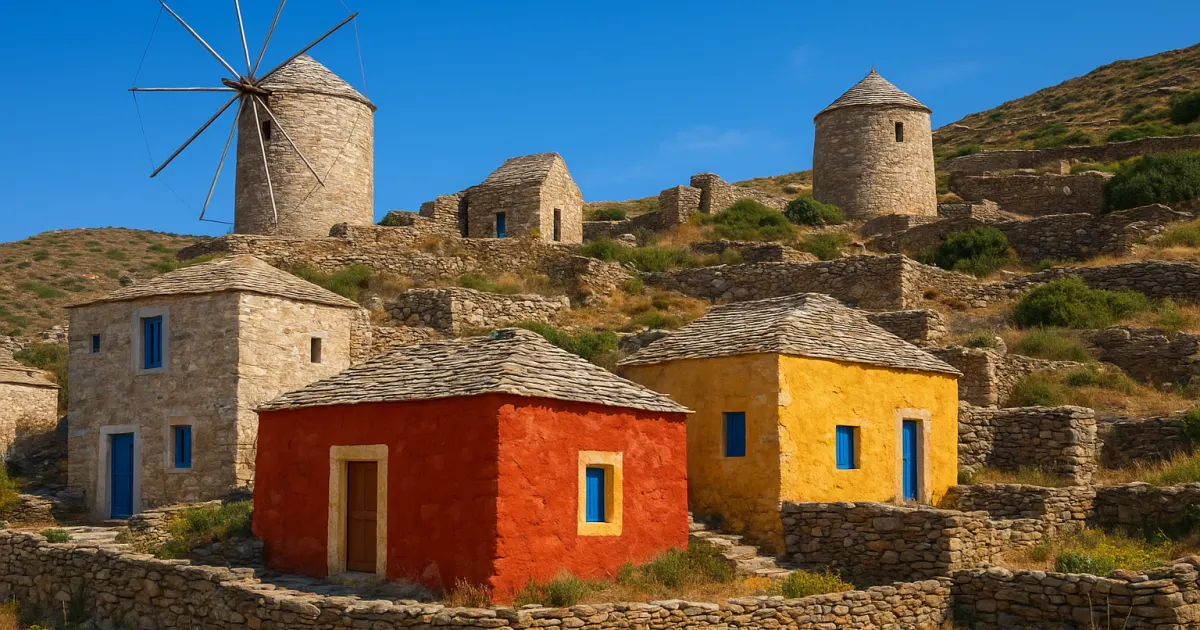
Colour is central to the story. Kea's mayor since 2019, Rena Velissaropoulou, told Euronews that the island has always been colourful, and that the white-and-blue palette associated with the Cyclades was imposed during the Metaxas regime of 1936 to 1940, with white chosen mainly for hygiene reasons. Old plasterwork, she said, almost always reveals colour underneath. The report also highlights miltos, a greyish-red stone quarried in pits in the Otzia area, whose shade is compared to the red seen at Knossos and which was once exported to Athens.
Beyond the town, the report points to the stone farmhouses known as kathikies, most of them now uninhabited, with some converted into tourist lodging. Stonemason and livestock farmer Dinos Vrettos explained that farmers avoided both hilltops, to escape the northerly winds, and ravines, to escape summer heat, and that builders reused stones from ancient structures; he added that houses are often bought by foreigners who try to preserve them. Along the Mylopotamos stream there were once 11 watermills, likely dating to Ottoman rule and operating until the Second World War before being abandoned by the 1980s; one is now a residence and another opens for visitors. Retired aviation worker Savvas Michael said keeping at least one alive helps young people understand what they have inherited.