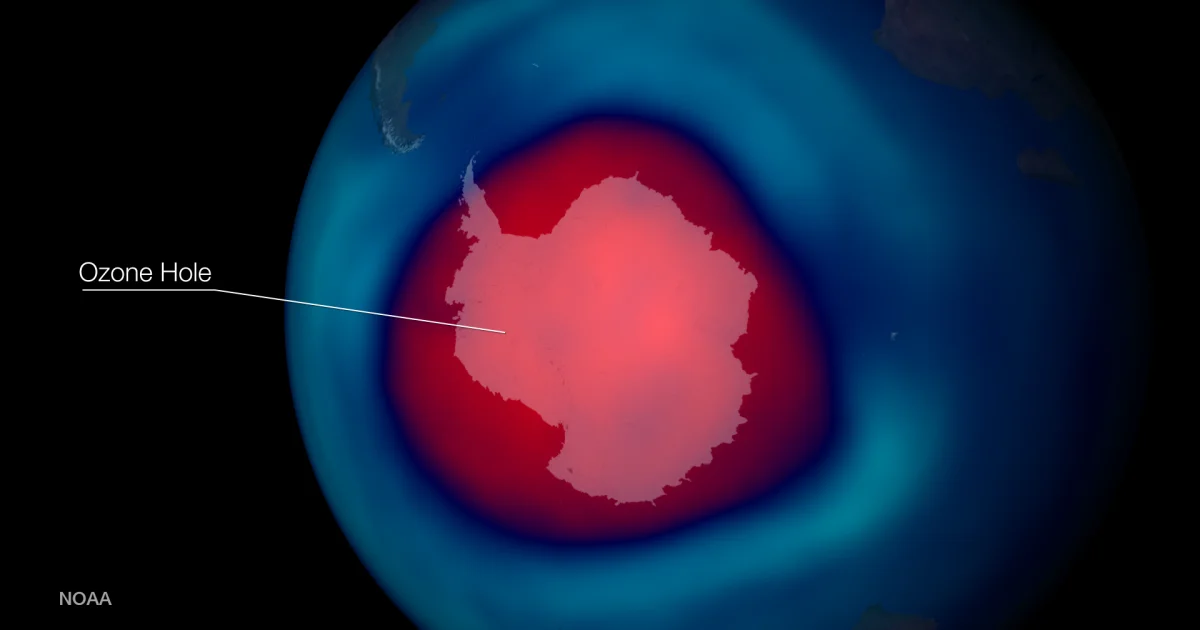
NASA and NOAA say an unusually strong polar vortex enlarged this year's Antarctic ozone hole to about 25 million square kilometres on average, yet the ozone layer is still expected to recover by the 2070s.
NASA and the US National Oceanic and Atmospheric Administration (NOAA) reported on Wednesday that the 2026 Antarctic ozone hole ranked as the seventh largest in 48 years of monitoring. Between 7 September and 13 October, the peak depletion season, it averaged about 9.6 million square miles (25 million square kilometres), and it reached its greatest single-day extent of 10.5 million square miles (27.1 million square kilometres) on 18 September. The agencies stressed that, despite its size, the hole was not as deep as other large holes on record, and that the ozone layer remains on track for long-term recovery.
Scientists attribute the larger hole to weather rather than to a reversal of recovery. Paul Newman of the University of Maryland, Baltimore County, who leads NASA's ozone research team, said an unusually powerful polar vortex extended depletion this season, producing a hole larger than any seen in a decade. Amy Butler of the NOAA Chemical Sciences Laboratory explained that planetary-scale weather systems that normally break up the vortex were especially weak in August and September, keeping the strongest winds several degrees of latitude farther from the pole and widening the area of cold conditions in which chlorine and bromine from human-made compounds destroy ozone. NOAA balloon measurements over the South Pole found ozone concentrations bottomed out at 105 Dobson units on 17 October, compared with the record low of 92 Dobson units in October 2006.
NASA and NOAA said the long-term trend still points to healing. Newman noted that the hole has been forming later in the season in recent years, and that the 2026 hole could have been 1 to 2 million square miles larger if ozone-depleting substances were as prevalent today as at their peak in 2000. The agencies credit the Montreal Protocol of 1987, under which countries agreed to replace such substances, and NOAA's Stephen Montzka said chlorine derived from them in the Antarctic stratosphere has fallen by about a third from its peak. Because legacy compounds from old refrigerators, air conditioners and insulation linger for decades, scientists estimate the ozone hole will recover by the 2070s.