
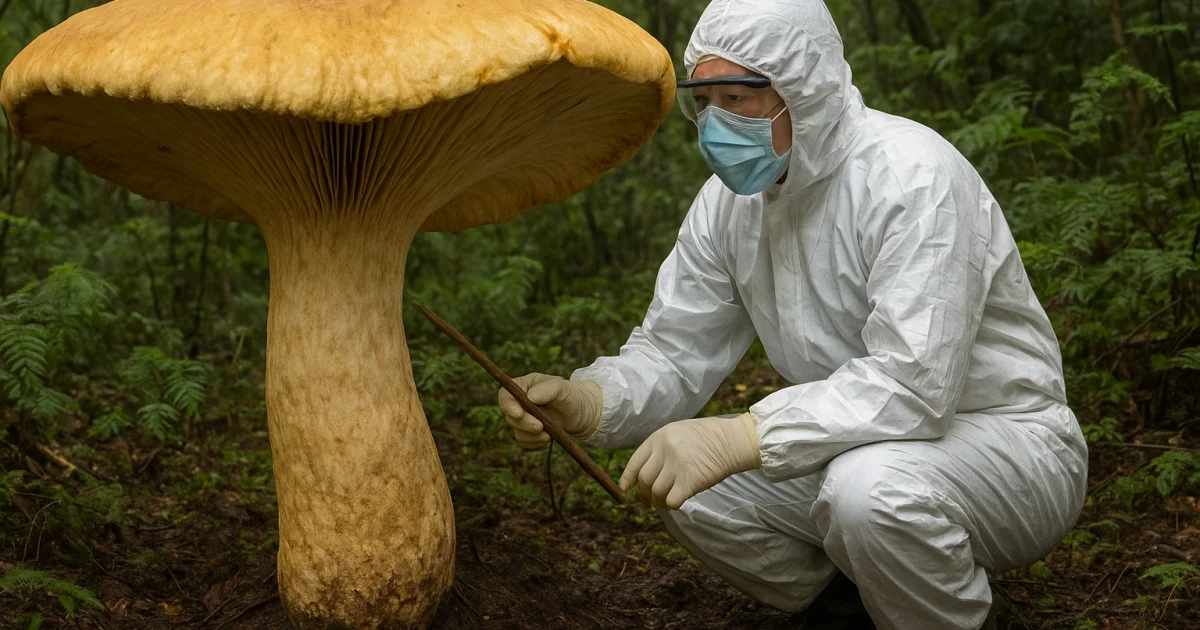
Scientists at the Kunming Institute of Botany describe Dianjunus rex, a new genus and family whose fruiting bodies reach 50 cm, taller than any previously known ascomycete.
Researchers from the Kunming Institute of Botany in China have described a giant fungus from the forests of Yunnan that they say is the largest of its kind. Named Dianjunus rex and nicknamed "D-rex", it produces upright reproductive structures, known as stromata, that can reach about 50 cm in height and weigh up to 2.2 kg. According to the study, published in Frontiers in Fungal Biology, these are the largest known fruiting bodies in the ascomycetes, a group of more than 64,000 recognised species. Earlier record holders in the group measured roughly 20 to 30 cm.
The team found the whitish structures growing from the woody roots of Chinese cork oak trees during surveys of temperate coniferous forest near Damaidi and Yipinglang and tropical rainforest near Nanbang. After collecting specimens, culturing spores and sequencing the genome, the researchers concluded that the fungus is distinct enough to require a new genus and a new family, Dianjunaceae, within the order Xylariales. Its closest known relative, Graphostroma platystoma, grows on dead hardwood in the Northern Hemisphere. Corresponding author Indunil Senanayake said the species offers a rare window into how extreme fungal body forms evolve, and the team believes it breaks down dead wood using enzymes typical of its order.
Using a molecular-clock analysis, the authors estimate that the family originated about 65 million years ago, roughly a million years after the mass extinction that ended the age of the non-avian dinosaurs. They suggest the sudden abundance of dead plant material may have created new opportunities for wood-decomposing fungi, though this is a hypothesis rather than a demonstrated cause. They also propose that a tall structure could help spread spores on the wind in dense forest, at a high energy cost. The researchers say the find shows how much fungal diversity remains undocumented in China's forests, where difficult terrain and seasonal fruiting have limited fieldwork. This report is based on the study's published findings as relayed in materials from Frontiers, and Reporix has not independently examined the specimens.