Over 1,645 Martian days, the rover's PIXL instrument detected fine and ultrafine dust grains that stick to materials such as Teflon, findings NASA says could shape spacesuit, habitat and crew-health planning.
NASA says its Perseverance rover has made the first on-site measurements of fine and ultrafine dust particles on Mars. Over 1,645 Martian days, the rover's PIXL X-ray spectrometer examined dust clinging to calibration targets and to samples of spacesuit material carried aboard. Earlier measurements on Mars resolved grains down to about 3 micrometers; PIXL detected particles smaller than 2.5 micrometers and ultrafine grains of around 100 nanometers. According to NASA, the findings are due to be published in the Proceedings of the National Academy of Sciences on 27 October.
The agency reports that particles on PIXL's Teflon target and on a Vectran swatch used by the SHERLOC instrument averaged about 2 micrometers, while grains on a basaltic glass target and a Teflon swatch ranged down to roughly 100 to 300 nanometers. Static electricity appears to decide which sizes stick to which surfaces, as grains charge through collisions in the air, and the finest particles stayed attached through years of driving and drilling. Teflon is an organic polymer of the kind common in outer spacesuit layers, and the results show it readily collects fine dust, while some materials held less. Lead author Scott VanBommel of Washington University in St. Louis said larger clumps shake off over time but the smallest particles remain.
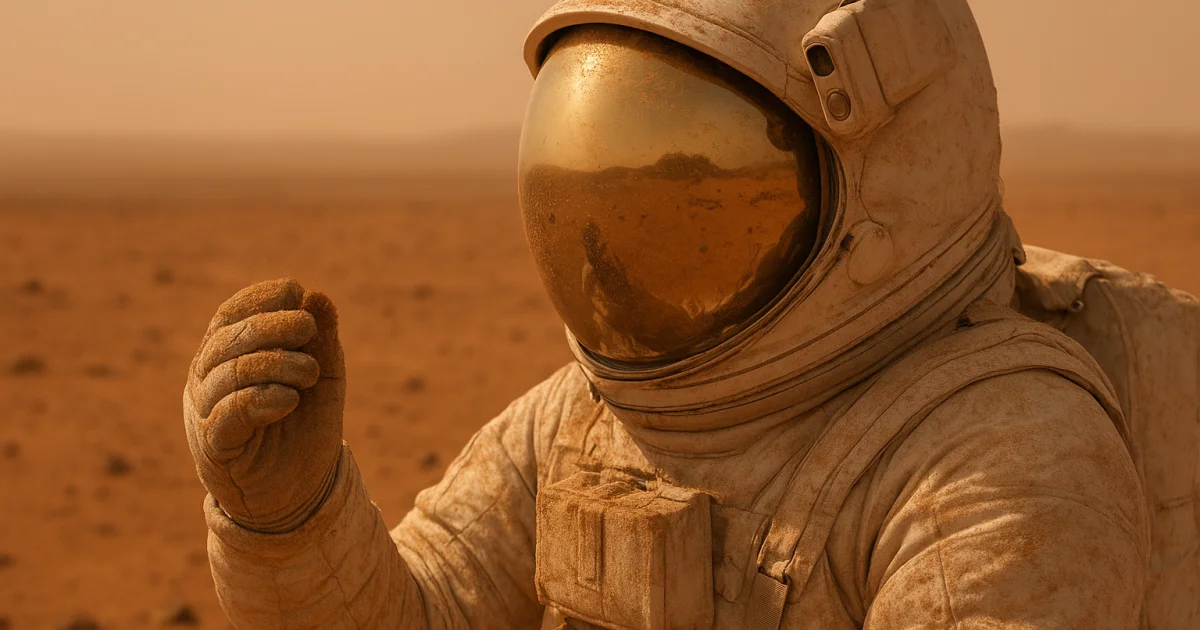
NASA notes that on Earth, particles below 2.5 micrometers can penetrate deep into the lungs and enter the bloodstream, and Martian dust carries reactive compounds such as perchlorates and reactive iron. The agency says health risks are believed to depend on how much dust people are exposed to and for how long, and that the work could inform spacesuit and habitat design, dust-removal procedures and indoor exposure limits for astronauts. Apollo crews dealt with lunar dust that scratched visors and damaged seals, and NASA points to designs such as suitports and dual-chamber airlocks as ways to limit how much dust enters living quarters. These are findings from one study as described by NASA, not a determination of actual health effects on future crews.