
Launched in 1977, NASA's Voyager 1 is set to become the first human-made object one light-day from Earth, more than 25.9 billion kilometres away, and the agency is inviting the public to mark the milestone.
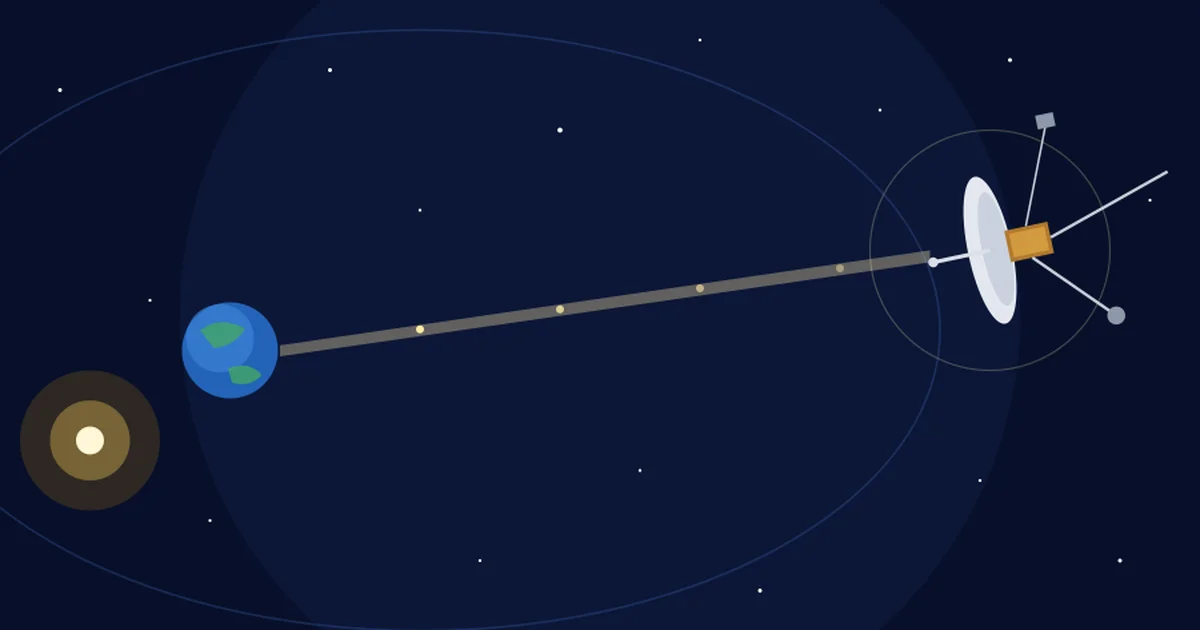
NASA says its Voyager 1 spacecraft will reach a distance of one light-day from Earth on Wednesday, 18 November 2026, nearly half a century after its launch in 1977. At that point the probe will be more than 25.9 billion kilometres (about 16 billion miles) away, so far that a signal travelling at the speed of light needs 24 hours to reach it. Voyager 1 is already the most distant human-made object, and the milestone gives a concrete sense of scale to a mission that has spent decades moving beyond the planets. The announcement comes from NASA and its Jet Propulsion Laboratory (JPL) in Southern California, which built the twin Voyager spacecraft and still operates them.
The agency plans two events around the date. On Tuesday, 17 November, NASA is asking people around the world to take part in "Shine Bright for Voyager's Light-Day", a symbolic wave of light after sunset, using a website that lets phones and tablets flash "VGR", Voyager's call sign, in Morse code. Participants are encouraged to share photos and videos on social media. On Thursday, 19 November, at 12 p.m. EST, JPL will host a moderated discussion with mission team members and NASA leaders on the status of Voyager 1 and Voyager 2, the science they still collect in interstellar space and the difficulty of keeping such old spacecraft working across enormous distances. The session, held in JPL's von Kármán Auditorium, will also preview a NASA+ documentary planned for 2027, the mission's 50th anniversary.
Voyager 1 and Voyager 2 were designed to explore the outer planets using a planetary alignment that occurs only once every 176 years. Voyager 1 crossed into interstellar space in 2012, and Voyager 2 followed on a different path in 2018. Both continue to send back observations from beyond the heliosphere, the protective bubble created by the Sun, through NASA's Deep Space Network. The light-day mark does not change the mission itself, but it shows how far engineering built in the 1970s has travelled, and why every command sent to Voyager 1 now takes a full day to arrive, with another day needed for its reply to come back.